
Last Updated: November 17, 2026
Quick Summary
To inspect used shipping container units before buying, open both doors and work through five areas in person: walls and frame, doors and seals, floor and corner castings, roof, and cargo history. Bring a flashlight, pry bar, camera, and moisture meter, and run a light test inside with the doors closed to catch leaks.
- Surface rust is normal on a used unit, but flaking rust that leaves a hole is not.
- Door gaskets should feel soft and unbroken; brittle seals let water and pests in.
- A floor that flexes or crunches underfoot has taken on water and needs replacement.
- The light test is fastest for leaks: close both doors, stand inside, look for pinholes.
- Ask for the grade in writing on the invoice and confirm the CSC plate date matches.
Table of Contents
- Why a Hands-On Inspection Beats a Listing Photo
- Your Used Shipping Container Inspection Checklist
- How to Check a Shipping Container for Leaks
- Used Shipping Container Condition Grades Explained
- Shipping Container Delivery Site Preparation
- Schedule a Container Inspection at K3 Containers
- Frequently Asked Questions
Why a Hands-On Inspection Beats a Listing Photo
A used shipping container can look fine in a photo and still hide a rusted floor, a bad door seal, or a leaky roof.
At K3 Containers, we keep our own inventory on a lot so buyers can walk up, open the doors, and pick their own unit.
Photos hide the things that cost you money later. A seller can angle a camera away from a soft floor or a bent locking bar.
A hands-on inspection answers three questions a photo never can:
- Does the steel still hold its shape?
- Do the doors close tight and lock?
- Is the floor dry and solid?
Those three answers decide whether a used container is a good deal or a repair bill waiting to happen.
Your Used Shipping Container Inspection Checklist
A good used shipping container inspection checklist covers five areas: the walls and frame, the doors and seals, the floor and corner castings, the roof, and the cargo history. Work through each one in order, and take notes as you go.
Bring a flashlight, a small pry bar, a camera, and a moisture meter if you have one. Then follow the checklist below.
Walls, Roof, and Structural Frame
Start with the outside walls. Look for dents, deep rust, and any spot where the steel has rusted through. Surface rust is normal on a used unit. Flaking rust that leaves a hole is not.
Check the roof from the ground or a ladder. Look for soft spots, standing water, and rust around the edges. Then step inside and look up. Any daylight through the roof is a leak.
The structural frame is the heavy steel box around the walls. Run your eyes along the top and bottom rails. Look at the welds.
Doors, Locking Bars, and Seals
Open and close both doors yourself. They should swing freely and line up when they shut.
Check the door gaskets, the rubber seals around the edges. They should be soft and unbroken. A cracked or missing seal lets water and pests in.
Look at the locking bars and hinges. They should move smoothly and lock tight. Rust on the cam locks is common, but they still need to turn.
Our shipping container terms every buyer should know guide explains the hardware and markings you will see on the doors.
Floor, Corner Castings, and the CSC Plate
Step across the floor and feel for soft spots. The floor is usually marine plywood. Water damage shows up as delamination, where the wood layers peel apart. Press a pry bar into any dark or stained spot to test it.
Look at the corner castings, the heavy steel blocks at each corner. These carry the load and lock containers together. Cracks or heavy rust here are a red flag.
Finally, find the CSC plate, the metal safety plate near the doors. It shows the container’s approval details, including the date of the last examination.
Cargo History and Chemical Residue
The hidden risk for a container headed to storage or an office conversion can also be what it carried. Residues from certain cargoes can linger in the plywood floor and in the seams long after the container is emptied.
Ask the seller what the unit last hauled and whether it ever carried hazardous materials. Look for staining, unusual odors, or a floor that has been painted over to hide marks.
How to Check a Shipping Container for Leaks
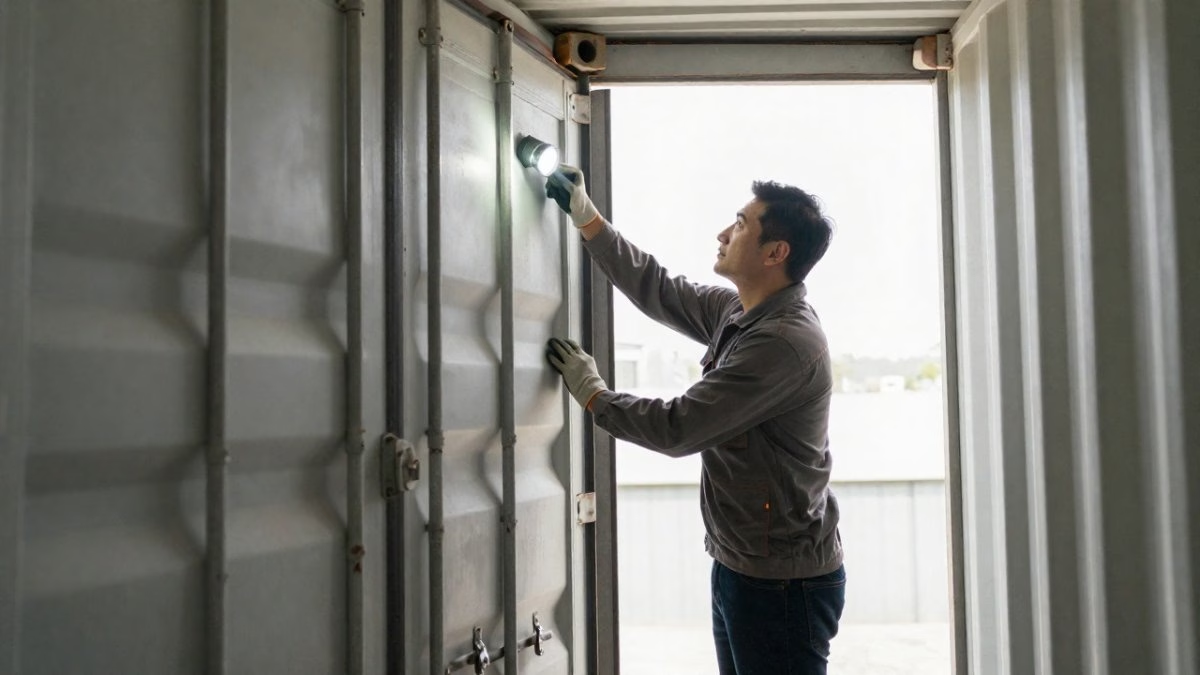
The fastest way to check a shipping container for leaks is the light test. Close both doors, stand inside, and look for pinhole leaks.
Do the light test on a sunny day for the best results. Run your eyes slowly along the seams, the roof line, and around the door frames.
Then check the floor for moisture. Look for water stains, soft wood, and rust on the steel cross-members underneath.
Watch out: a container that is level and sealed still needs airflow. A closed unit with no ventilation can build up condensation inside over time.
Used Shipping Container Condition Grades Explained
Used containers are sold in grades, and the grade tells you what to expect. The common grades are one-trip, cargo worthy, wind and watertight, and as-is.
- One-trip: Used once to ship goods. Nearly new.
- Cargo worthy: Meets standards for hauling freight again.
- Wind and watertight: Keeps out wind and rain but is not approved for cargo.
- As-is: Sold in current condition, often with visible damage.
A hands-on look is the most reliable way to judge a container’s current condition. Read the full definitions in our guide to shipping container grades and conditions before you compare units.
How to Verify the Grade Yourself
A grade is only as good as the seller behind it. Before you accept a grade, check the CSC plate for the last examination date and confirm it matches the condition you see. A unit sold as cargo worthy should have a current plate and tight doors.
Walk the unit against the grade you are being quoted. If the seller calls it cargo worthy but the floor flexes or a locking bar will not engage, the grade is wrong.
Verify the Seller Owns the Unit
Containers are sometimes leased, and a leased unit is not the seller’s to sell. Ask for the container identification number and confirm it matches the unit you are looking at.
Watch out: a seller who cannot produce ownership paperwork, or who pressures you to pay before you see the unit, is a risk. Our guide on avoiding container scams walks through the red flags.
Used containers are sold in grades, and each grade tells you what to expect before you inspect.
| Grade | What it means |
|---|---|
| One-trip | Used once to ship goods; nearly new |
| Cargo worthy | Meets standards for hauling freight again |
| Wind and watertight | Keeps out wind and rain; not approved for cargo |
| As-is | Sold in current condition, often with visible damage |
Shipping Container Delivery Site Preparation
A shipping container needs a firm, level, well-drained base before it lands. Containers need space off the ground so they do not settle.
K3 Containers levels containers before placement. During wet seasons, a container set flat on dirt can sink or shift, and that throws the doors out of line.
Plan your site before delivery:
- Clear a flat area the truck can reach.
- Choose a base like gravel, ties, or blocks.
- Make sure water drains away from the unit.
Our guide on what to put under a shipping container compares gravel, ties, blocks, and slabs.
Schedule a Container Inspection at K3 Containers
The best inspection is the one you do yourself, on a lot, with the doors open.
K3 Containers has been in the container business for nearly four years. We grade containers by current condition, repair damaged containers, and build and make container offices for job sites and businesses that need workspace.
You can browse used shipping containers for sale and compare sizes and conditions before you visit.
Watch out: buying from a seller who does not let you inspect in person is a gamble.
A used container is only a good deal if the steel, doors, and floor are sound. Do not buy on a photo alone.
K3 Containers offers new, one-trip, and used 20-foot and 40-foot containers, flexible rent-to-own options, and dependable delivery across Central Texas.
Frequently Asked Questions
How can you tell if a used shipping container is in good condition?
Start with the structure. Look for dents and dings that push into the wall, corrosion around the corner castings and cross-members, and welds that show cracking. Open and close the doors yourself and check that the locking bars move freely and the door gaskets sit flat. Inside, walk the floor for soft spots or floor delamination in the marine plywood, and check the roof for pinhole leaks. A container that is wind and watertight and structurally sound is in good condition for storage use.
What should you inspect on shipping container doors and floors?
On the doors, check the hinges, cam locks, and locking bars for rust and free movement, and run a hand along the door seals to feel for gaps or hardening. On the floor, look for moisture damage, staining, and any spot that gives underfoot, since marine plywood can delaminate from the underside. Also check where the floor meets the walls for corrosion. K3 Containers keeps its own inventory at its lot so buyers can open the doors and inspect both before paying.
Do shipping containers get inspected, and what is the CSC plate?
New containers are inspected and fitted with a CSC plate under the International Convention for Safe Containers, which shows the container number, prefix, and check digit along with inspection dates. Used containers may have an expired plate, so treat it as a starting reference rather than proof of current condition. Your own yard inspection, covering the structural frame, corner castings, and door seals, tells you more about how the unit will perform as storage than the plate alone.
What damage is acceptable on a used shipping container?
Surface rust, dents and dings that do not break the wall, and cosmetic paint wear are normal on a used unit and do not affect structural integrity. Walk away from holes, pinhole leaks in the roof, bent corner castings, cracked welds, or doors that will not close and seal. K3 Containers grades containers by current condition, including one-trip, cargo worthy, wind and watertight, and as-is, so you know exactly what you are buying before delivery.