

K3 Buyer Guide
Shipping container terms should help you buy smarter—not confuse you.
This glossary explains the words buyers hear most often when comparing containers for storage, construction, farm, ranch, church, school, and business use in Waco and Central Texas.
Quick Buyer Glossary
- One-trip
- A container that has generally made one cargo trip from the manufacturer. It is usually the cleanest-looking option, but may still have handling marks.
- Cargo worthy
- A used container considered structurally suitable for cargo transport after inspection. It may have dents, surface rust, repairs, and cosmetic wear.
- Wind- and watertight
- A storage-focused condition description indicating that the unit should keep out normal wind and rain. It does not guarantee ocean-shipping eligibility, attractive appearance, or odor-free floors.
- As-is
- Sold in its current condition without a broad condition guarantee. Inspection and written details are especially important.
- High cube
- A container that is typically one foot taller than a standard-height unit, providing more headroom for shelving, tall equipment, insulation, or modifications.
- Lockbox
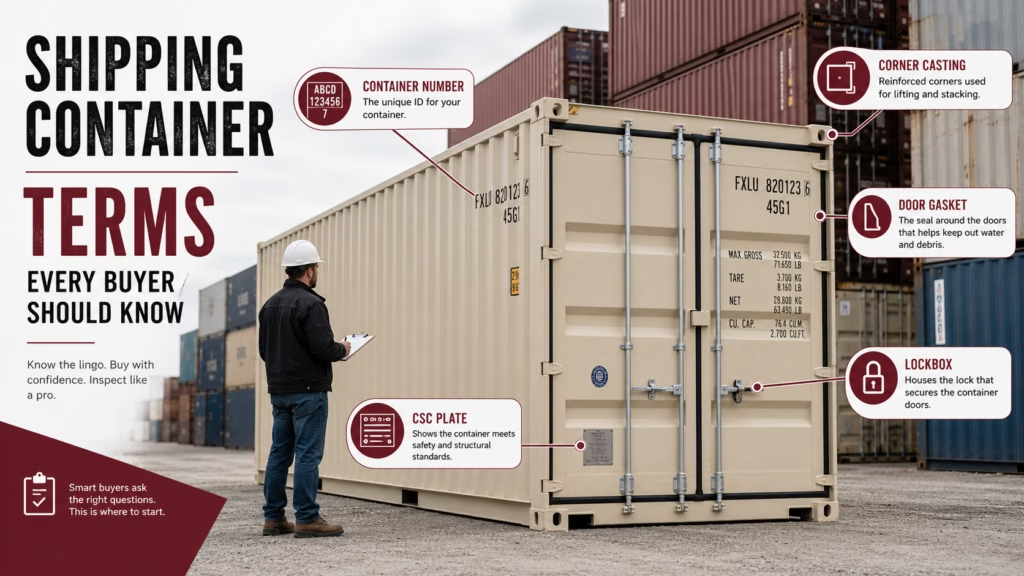
- A steel shield around the padlock area that helps reduce access to bolt cutters and other tools.
- Corner casting
- The heavy steel fitting at each corner used for lifting, stacking, securing, and transporting the container.
- Crossmember
- A steel support underneath the wood floor. Damaged or heavily rusted crossmembers can affect floor strength.
- Door gasket
- The rubber seal around the cargo doors. Cracked, missing, or poorly aligned gaskets can allow water and dust inside.
- Tare weight
- The empty weight of the container.
- Maximum gross weight
- The combined maximum allowed weight of the container and cargo for transport use.
TEU and FEU
TEU means Twenty-foot Equivalent Unit and is the standard unit used to express container capacity. The term FEU is commonly used informally for a 40-foot container, but a 40-foot unit does not always have exactly twice the usable internal volume or payload of a 20-foot unit.
Container Number and ISO Size/Type Code
The large identification number on the doors normally includes an owner code, equipment category letter, serial number, and check digit. A separate ISO size/type code identifies dimensional and equipment characteristics. These codes are useful for matching photos, paperwork, and the exact unit being sold.
CSC Plate
The Convention for Safe Containers plate contains manufacturing and safety-approval information. It is most important when a container will return to international transport. A stationary storage buyer should still inspect the plate and container number, but an older inspection date does not automatically make a unit unusable for ground-level storage.
Common Container Types
- Dry container: the standard enclosed steel container most K3 buyers use for storage.
- Reefer: an insulated refrigerated container requiring specialized electrical and mechanical systems.
- Open top: designed for oversized cargo loaded from above.
- Flat rack: a platform-style unit for oversized or heavy cargo.
Questions to Ask Before You Buy
- What condition is guaranteed in writing?
- Are the photos of the exact unit or a representative unit?
- Is it standard height or high cube?
- Do the doors operate properly?
- Are the roof, floor, seals, lower rails, and crossmembers sound?
- What is the total delivered price?
Now that the terms make sense, browse containers for sale and you'll know exactly what each listing means.
Not sure what a listing term means?
Call K3 before you buy. We can explain container condition, size, delivery requirements, and total delivered pricing.